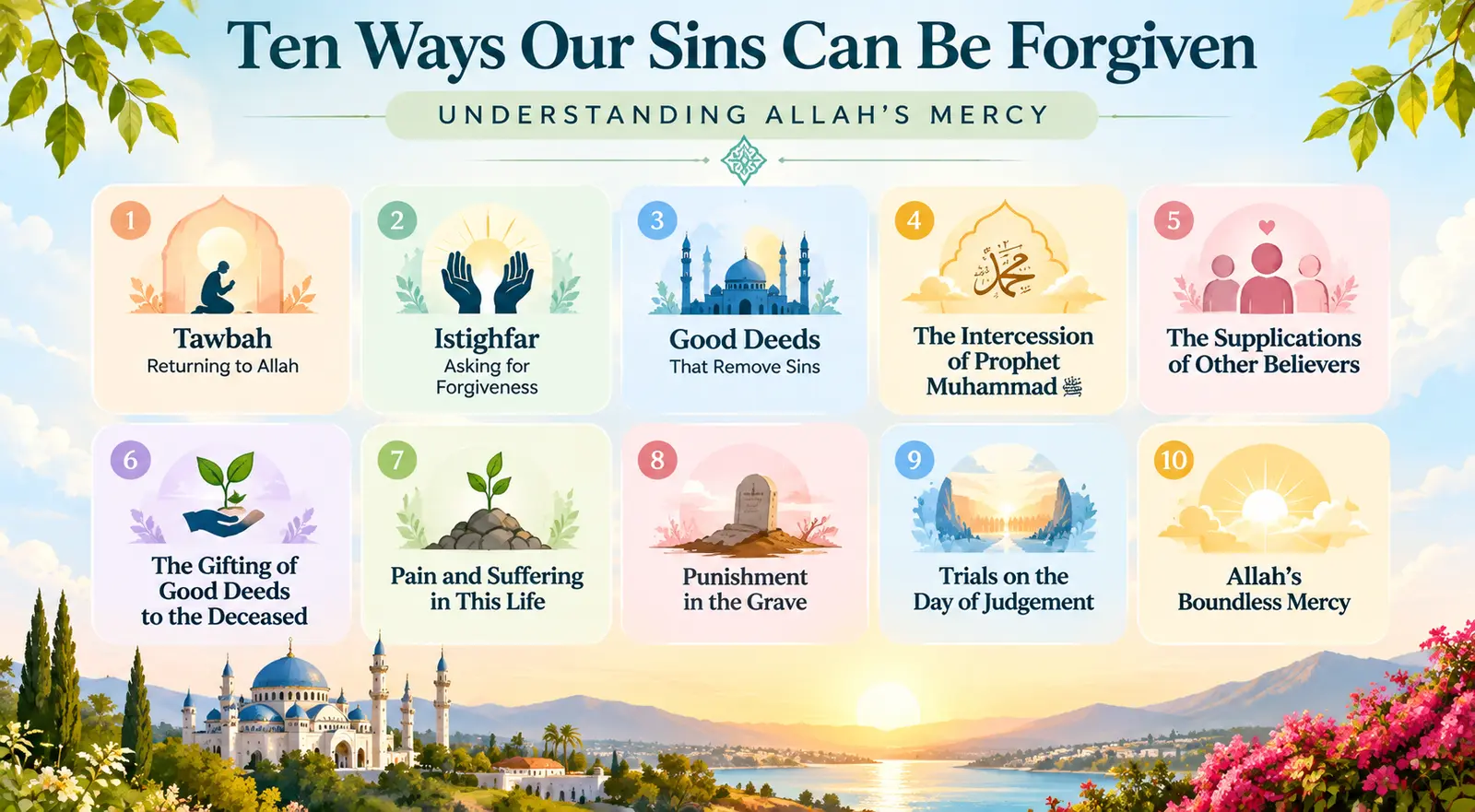
What are the different ways through which our sins may be forgiven? The Quran and Sunnah describe multiple pathways to forgiveness. Some are within our control, while others depend on circumstances beyond it. Understanding these ten pathways offers insight into the different ways through which Allah may forgive sins.
1. Tawbah: Returning to Allah
The first pathway is tawbah, or repentance. Tawbah means returning to Allah after committing a sin. It involves feeling regret for having committed the sin and turning back to Him.
Tawbah is broader than simply asking for forgiveness. It is the act of returning to Allah, and regret lies at its essence.
The Prophet Muhammad ﷺ taught that whoever sincerely repents from a sin is like one who has not committed it. Tawbah is one of the most important and effective means of forgiveness, and it is within our control.
2. Istighfar: Seeking Forgiveness
The second pathway is istighfar, which means asking Allah for forgiveness.
Although tawbah and istighfar are closely connected, they are not identical. Tawbah is the broader act of returning to Allah, while istighfar specifically means seeking His forgiveness.
The Prophet Muhammad ﷺ sought Allah’s forgiveness more than a hundred times a day, demonstrating the importance of this practice.
Tawbah and istighfar are among the most important pathways to forgiveness because they are within our control and offer a direct means of seeking Allah’s forgiveness.
3. Good Deeds That Remove Sins
The third pathway is performing good deeds.
Allah says in the Quran:
“Indeed, good deeds do away with misdeeds.” — Quran 11:114وَأَقِمِ ٱلصَّلَوٰةَ طَرَفَىِ ٱلنَّهَارِ وَزُلَفًۭا مِّنَ ٱلَّيْلِ ۚ إِنَّ ٱلْحَسَنَٰتِ يُذْهِبْنَ ٱلسَّيِّـَٔاتِ ۚ ذَٰلِكَ ذِكْرَىٰ لِلذَّٰكِرِينَAnd establish prayer at the two ends of the day and at the approach of the night. Indeed, good deeds do away with misdeeds. That is a reminder for those who remember.Hud 11:114 · Sahih International
The Prophet ﷺ illustrated this through the example of a person who bathes five times a day. Just as bathing removes physical dirt, the five daily prayers serve as a means of removing sins.
Other examples include wudu, one Ramadan followed by another, and one Hajj followed by another, which are described in the relevant Islamic teachings as means of expiation.
The Prophet ﷺ also recounted the case of a man who confessed to having flirted with and kissed a woman. After the man prayed with the Prophet ﷺ and his companions, the Prophet ﷺ reminded him that he had prayed with them and performed good deeds.
Good deeds, including the regular acts of worship mentioned above, are among the pathways through which sins may be forgiven.
4. The Intercession of Prophet Muhammad ﷺ
The fourth pathway is the intercession, or shafa’ah, of Prophet Muhammad ﷺ for his Ummah, by Allah’s permission.
During his lifetime, the companions could approach the Prophet ﷺ and ask him to supplicate to Allah on their behalf. Islamic teachings also describe his intercession for his Ummah on the Day of Judgement.
The Prophet ﷺ expressed concern for his followers and will ask Allah for their forgiveness. However, Allah determines who receives the benefit of this intercession.
One practice associated with seeking this blessing is making the supplication after the adhan, asking Allah to grant the Prophet ﷺ al-wasilah and the praised station. The Prophet ﷺ taught that whoever makes this supplication sincerely will be entitled to his intercession.
5. The Supplications of Other Believers
The fifth pathway is the dua of other believers asking Allah to forgive someone.
The Prophet ﷺ taught the virtue of praying for another Muslim in their absence. When a believer makes such a supplication, an angel says, “And for you the same.”
People are often remembered in the prayers of others because of the impact they had on their lives. Those who helped others, showed generosity, and touched people’s hearts may be remembered with gratitude and sincere dua.
The funeral prayer is another example of believers asking Allah to forgive the deceased. A narration mentioned in this context states that when three rows of people pray over a deceased person, forgiveness is granted.
6. The Gifting of Good Deeds to the Deceased
The sixth pathway is the gifting of good deeds to someone who has passed away. This differs from making dua for the deceased.
A person may perform a good deed and dedicate its reward to someone who has died. This is discussed as a means through which the deceased may receive benefit and have their sins forgiven.
For example, some teachers have performed acts of worship on behalf of earlier Islamic scholars because they benefited greatly from their writings and knowledge. Such acts reflect the gratitude they feel towards those whose work has benefited them.
This pathway is less common than making supplications for the deceased, as it depends on others choosing to perform good deeds on their behalf.
7. Pain and Suffering in This Life
The seventh pathway is the pain and suffering experienced during life.
The Prophet ﷺ taught that anxiety, grief, worry, stress, and physical pain can become means through which a believer’s sins are forgiven. Even the prick of a thorn is mentioned in this context.
Suffering is not limited to physical pain. Psychological distress, anxiety, grief, and stress can also be deeply difficult experiences.
These trials extend throughout life, including the pain experienced near death. Through such suffering, sins may be expiated.
8. Punishment in the Grave
The eighth pathway concerns punishment in the grave.
Some people may experience punishment in the grave, and this punishment may serve as an expiation for their sins rather than their receiving the corresponding punishment in the Hereafter.
Examples include those who lie, deceive others, and deliberately create conflict between people, including those who damage friendships and marriages.
This is distinct from the pain and suffering experienced during life. Punishment in the grave is not something to seek, but it is included among the possible means of expiation discussed in Islamic teachings.
9. Trials on the Day of Judgement
The ninth pathway concerns the distress that some people may experience on the Day of Judgement.
These trials may include being denied shade or water and experiencing the fear associated with the prospect of entering Hellfire.
Some people may face the prospect of being taken to Hellfire before being forgiven at the last moment. The distress they experience may serve as an expiation for their sins.
Such trials are not something to desire. We seek Allah’s protection from the distress of the Day of Judgement and ask Him to grant us security on that day.
10. Allah’s Boundless Mercy
The tenth pathway is Allah’s mercy, through which He may choose to forgive someone without any of the preceding nine mechanisms.
Allah chooses according to His will and wisdom. There may be reasons for His forgiveness that human beings do not know or fully understand.
The Quran reminds us that if Allah knows goodness in a person’s heart, He can grant them something better than what has been taken away.
There are also narrations concerning people who had not performed good deeds in their lives but were nevertheless forgiven by Allah.
This final pathway highlights that Allah’s forgiveness is not limited to the nine preceding mechanisms. His mercy encompasses what lies beyond our knowledge and understanding
Something to reflect upon…
If Allah has opened so many doors to forgiveness, are we making the most of the opportunities He has given us? When we sin, do we turn back to Him, or do we allow ourselves to drift further away? How will we be remembered by those whose lives we touch, and what will remain of us when we are gone? And when we finally stand before Allah, will we rely on our deeds alone, or will we stand in humble hope of His mercy?