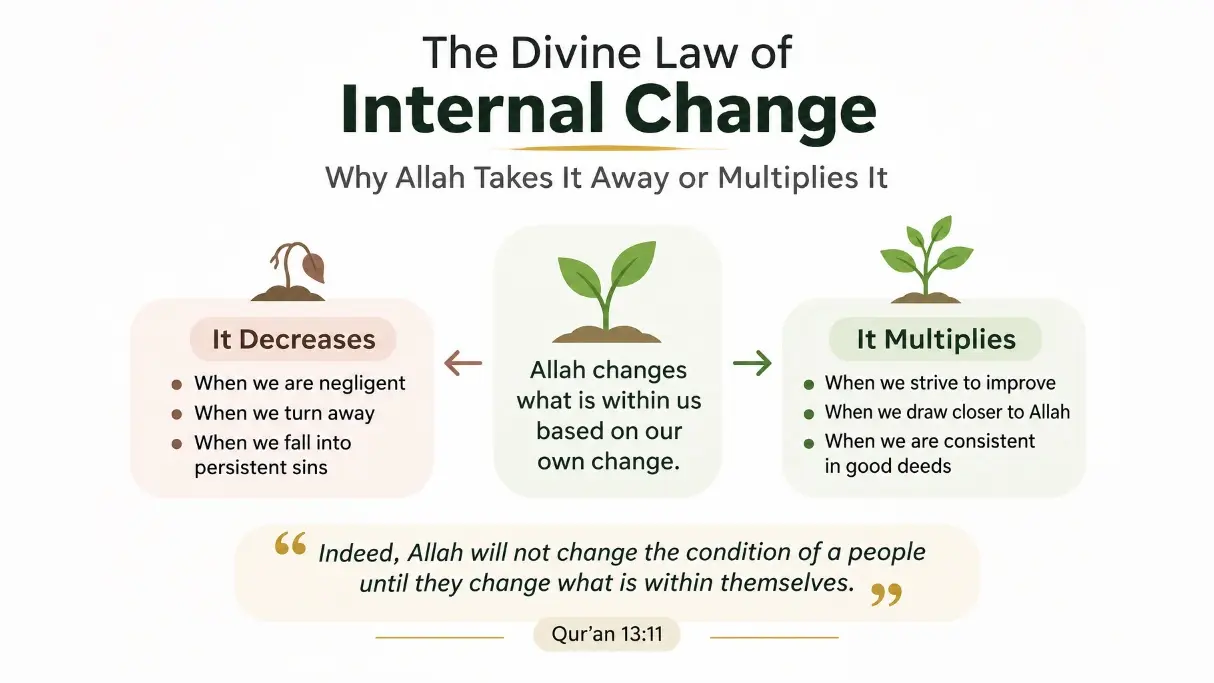
إِنَّ ٱللَّهَ لَا يُغَيِّرُ مَا بِقَوْمٍ حَتَّىٰ يُغَيِّرُوا۟ مَا بِأَنفُسِهِمْ
“Indeed, Allah will not change the condition of a people until they change what is in themselves.”
Surah Ar-Ra’d 13:11
Every individual and community experiences cycles of prosperity, security, health, and comfort. Yet human nature is prone to a dangerous blind spot: treating these continuous favors (ni’am) as self-earned entitlements rather than divine trusts.
At the heart of this verse lies a bedrock Qur’anic principle governing divine favor: Allah never arbitrarily rescinds a blessing He has bestowed. When a household, an organization, or a civilization sees its blessings collapse, the catalyst is rarely external. It almost invariably traces back to an unseen, internal shift in character, gratitude, and moral responsibility.
The Universal Rule: The Law of Cause and Effect
The Qur’an establishes a clear spiritual maxim in Surah Ar-Ra’d (13:11)لَهُۥ مُعَقِّبَٰتٌۭ مِّنۢ بَيْنِ يَدَيْهِ وَمِنْ خَلْفِهِۦ يَحْفَظُونَهُۥ مِنْ أَمْرِ ٱللَّهِ ۗ إِنَّ ٱللَّهَ لَا يُغَيِّرُ مَا بِقَوْمٍ حَتَّىٰ يُغَيِّرُوا۟ مَا بِأَنفُسِهِمْ ۗ وَإِذَآ أَرَادَ ٱللَّهُ بِقَوْمٍۢ سُوٓءًۭا فَلَا مَرَدَّ لَهُۥ ۚ وَمَا لَهُم مِّن دُونِهِۦ مِن وَالٍFor each one are successive [angels] before and behind him who protect him by the decree of Allah. Indeed, Allah will not change the condition of a people until they change what is in themselves. And when Allah intends for a people ill, there is no repelling it. And there is not for them besides Him any patron.Ar-Ra'd 13:11 · Sahih International and Surah Al-Anfal (8:53)ذَٰلِكَ بِأَنَّ ٱللَّهَ لَمْ يَكُ مُغَيِّرًۭا نِّعْمَةً أَنْعَمَهَا عَلَىٰ قَوْمٍ حَتَّىٰ يُغَيِّرُوا۟ مَا بِأَنفُسِهِمْ ۙ وَأَنَّ ٱللَّهَ سَمِيعٌ عَلِيمٌۭThat is because Allah would not change a favor which He had bestowed upon a people until they change what is within themselves. And indeed, Allah is Hearing and Knowing.Al-Anfaal 8:53 · Sahih International: Allah does not alter the outward favors granted to a people until an internal transformation occurs first.
Blessings do not evaporate without reason. Comfort, stability, and growth persist as long as the internal spiritual posture remains grounded. When internal humility degrades into entitlement, heedlessness, and arrogance, the outward environment shifts to reflect that decay.
Throughout scripture, every prophet directed their community to reflect on this link between internal posture and external favors:
Prophet Hud
Reminded the people of 'Aad to remember how Allah granted them strength and made them successors after the people of Nuh.
Prophet Shu'ayb
Reminded the people of Madyan to contemplate their beginnings: “And remember when you were few and He increased you” (Surah Al-A'raf 7:86وَلَا تَقْعُدُوا۟ بِكُلِّ صِرَٰطٍۢ تُوعِدُونَ وَتَصُدُّونَ عَن سَبِيلِ ٱللَّهِ مَنْ ءَامَنَ بِهِۦ وَتَبْغُونَهَا عِوَجًۭا ۚ وَٱذْكُرُوٓا۟ إِذْ كُنتُمْ قَلِيلًۭا فَكَثَّرَكُمْ ۖ وَٱنظُرُوا۟ كَيْفَ كَانَ عَٰقِبَةُ ٱلْمُفْسِدِينَAnd do not sit on every path, threatening and averting from the way of Allah those who believe in Him, seeking to make it [seem] deviant. And remember when you were few and He increased you. And see how was the end of the corrupters.Al-A'raaf 7:86 · Sahih International).
Prophet Musa
Commanded Bani Isra'il to recall how Allah rescued them from the oppression of Pharaoh and his armies.
The Sahabah
Were reminded of their pre-Islamic enmity, when tribal warfare consumed them, until Allah united their hearts and established them as a unified brotherhood through faith.
To preserve existing favors and invite growth, the Qur’an outlines actionable internal changes:
1. Triple-Tiered Gratitude (Shukr)
Allah guarantees in Surah Ibrahim:
“If you are grateful, I will surely increase you [in favor].”
Surah Ibrahim 14:7وَإِذْ تَأَذَّنَ رَبُّكُمْ لَئِن شَكَرْتُمْ لَأَزِيدَنَّكُمْ ۖ وَلَئِن كَفَرْتُمْ إِنَّ عَذَابِى لَشَدِيدٌۭAnd [remember] when your Lord proclaimed, 'If you are grateful, I will surely increase you [in favor]; but if you deny, indeed, My punishment is severe.' "Ibrahim 14:7 · Sahih International
True gratitude is not a passive sentiment; it operates across three unified layers:
The Heart
Genuinely recognizing that every resource, skill, and milestone is an unearned gift from Allah—not an innate personal entitlement.
The Tongue
Regularly and authentically praising Allah (Alhamdulillah), acknowledging His agency before acknowledging one’s own efforts.
The Limbs
Actively employing the blessing in obedience and beneficial work. Using surplus wealth for charity, physical health for service, and leisure time to build community welfare.
2. Devotion During Times of Ease
Human nature prompts desperate prayer when calamity strikes, only to return to indifference once the storm passes. True spiritual alignment is proven when life is smooth and secure. Maintaining regular worship (salah), remembrance (dhikr), and supplication (du’a) during peak comfort acts as a safeguard against sudden loss.
3. Channelling Specific Gifts into Service
When an individual uses their distinct personal advantage to uplift others, Allah protects that gift:
- The Model of Prophet Musa: Endowed with extraordinary physical strength, Musa repented after an accidental death and pledged: “My Lord, for the favor You bestowed upon me, I will never be an assistant to criminals” (Surah Al-Qasas 28:17قَالَ رَبِّ بِمَآ أَنْعَمْتَ عَلَىَّ فَلَنْ أَكُونَ ظَهِيرًۭا لِّلْمُجْرِمِينَHe said, "My Lord, for the favor You bestowed upon me, I will never be an assistant to the criminals."Al-Qasas 28:17 · Sahih International). He immediately directed that physical power toward helping two vulnerable women draw water from a deep well because their elderly father was unable to do the heavy labor.
- Whether our primary asset is technical acumen, administrative leadership, financial surplus, or physical stamina, dedicating a portion of it to communal service preserves and expands it.
4. Proclaiming Favor Without Vanity (Tahadduth bi-Ni’mah)
The Qur’an encourages reporting Allah’s favors (Surah Ad-Duha 93:11وَأَمَّا بِنِعْمَةِ رَبِّكَ فَحَدِّثْBut as for the favor of your Lord, report [it].Ad-Dhuhaa 93:11 · Sahih International), provided it is done to give credit to the Almighty and inspire hope, rather than to fuel personal branding or self-aggrandizement.
Conversely, the Qur’an highlights three internal corruptions that trigger the loss of blessings:
1. Ingratitude for Favors (Kufr an-Ni'mah)
Failing to appreciate blessings or utilizing them in ways that actively harm others or violate moral boundaries.
2. Heedlessness and Entitlement (Ghaflah)
The mindset that says, “This was purely my knowledge, my work ethic, and my strategy.” When individuals attribute success entirely to themselves, they sever their connection to the true Provider.
3. Arrogance and False Superiority (Kibr)
Using status, wealth, or influence to demean others. When a blessing breeds pride instead of empathy, it ceases to benefit its bearer, prompting its divine revocation.
The historical account of the People of Saba (Sheba) in Yemen illustrates this principle. Blessed with lush, twin expanses of gardens and secure trade routes, their prosperity eroded once they turned away from spiritual values and grew boastful. The catastrophic collapse of the Great Dam of Ma’rib subsequently washed away their wealth, replacing their orchards with barren, bitter shrubs.
Calamity: A Punitive Loss or an Elevating Trial?
Not every loss signifies divine displeasure. The life of Prophet Ayyub (Job) demonstrates that righteous individuals can endure the total loss of health, wealth, and family without having done anything wrong. In his case, the trial was designed to elevate his rank and grant him greater reward upon steadfast perseverance (sabr).
How can an individual distinguish between a punishment and a test?
The answer is not found in what was taken away, but in the internal response to the loss:
A Sign of Punishment
The hardship breeds cynicism, bitterness, despair, and rebellion against God, hardening the heart further.
A Sign of Divine Elevation
The hardship softens the heart, drives sincere repentance (tawbah), deepens humility, and brings the individual closer to the Creator in persistent prayer.
Practical Steps for Community and Self
- Audit Internal Attribution: When reviewing a project milestone or personal achievement, deliberately check the internal dialogue. Replace “I built this” with “Allah facilitated this through me.”
- Anchor Gratitude in Service: Take your primary capability—whether in technology, mentorship, or resources—and direct a measurable fraction toward an initiative that serves vulnerable members of society.
- Inspect the Response to Hardship: When unexpected friction occurs, look inward first. Treat every trial as an invitation to realign internal intentions, seek forgiveness (istighfar), and renew purposeful action.
Published as part of the community reflections series on Amity Forum.