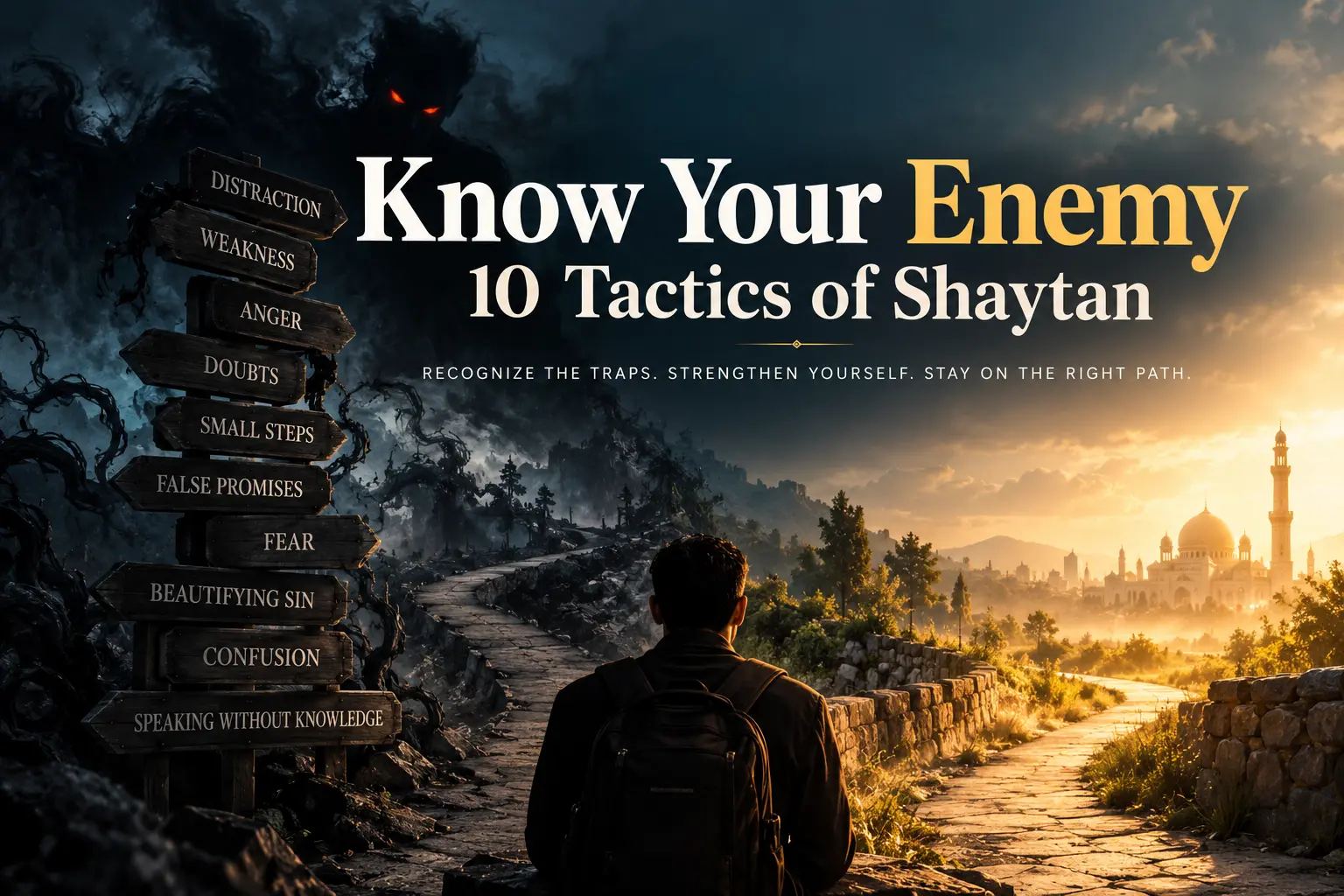
Shaytan rarely needs to convince someone to commit a major sin immediately. Sometimes all he needs is a distraction. A moment of anger. A suspicious thought. A small compromise that seems harmless. One step leads to another, and eventually a person may wonder: How did I end up here?
The Qur’an does not leave us unaware of these methods. Allah exposes the ways Shaytan attempts to influence human beings so that we can recognize the pattern before following it.
Think of it like recognizing a scam. Once you know how the scam works, the suspicious promise immediately raises an alarm. The same principle applies here: knowing the tactics of Shaytan makes us better prepared to resist them.
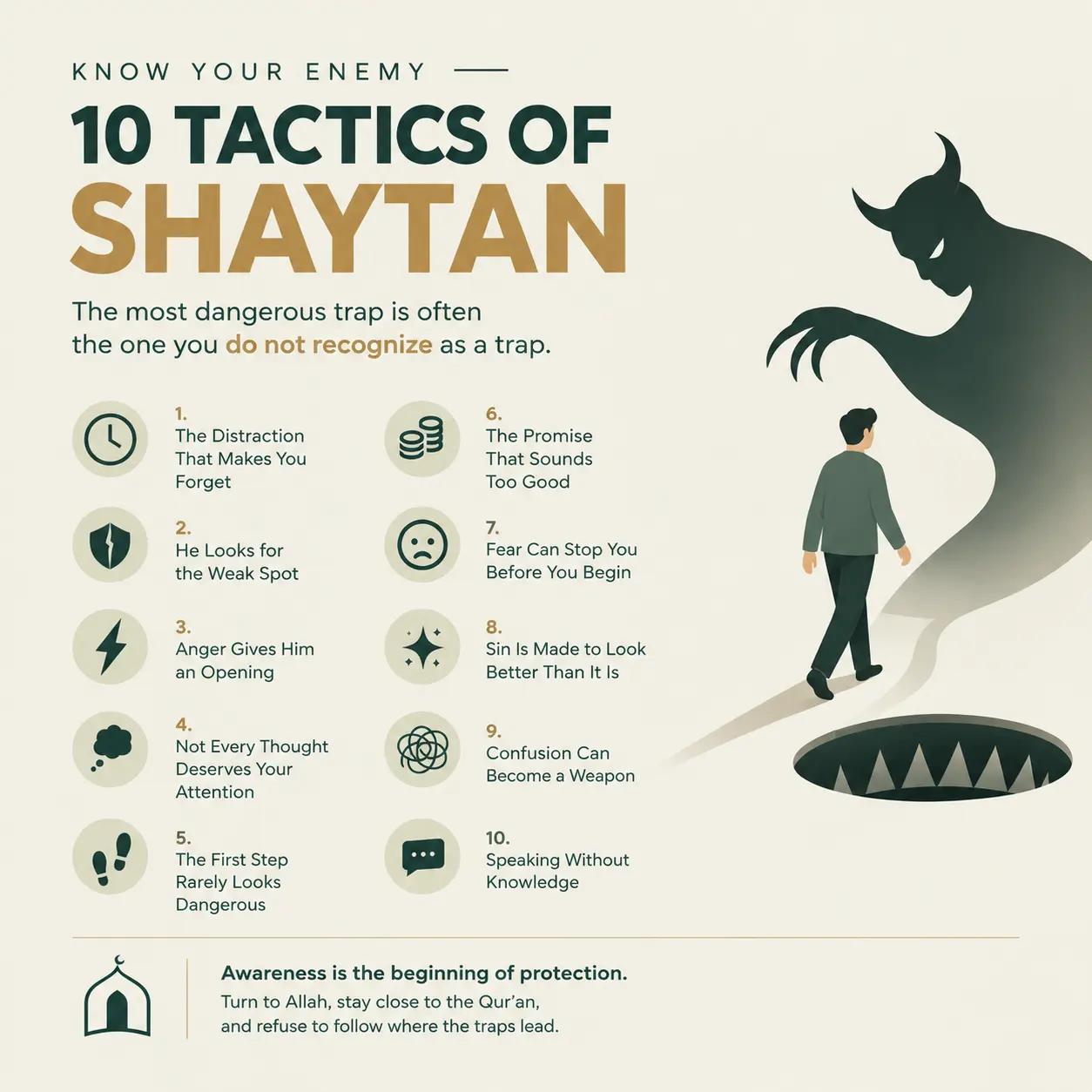
Here are ten traps worth learning to recognize.
1. The Distraction That Makes You Forget
Not every attack looks like temptation. Sometimes it simply looks like distraction.
You know it is time for Asr. You intend to pray shortly, but something occupies your attention. One thing leads to another, and suddenly the prayer time has passed.
If the forgetting is genuinely unintentional, Allah in His mercy does not hold a person sinful for what was truly forgotten. Yet there is still something important to notice: causing people to forget is one of the tactics attributed to Shaytan.
That makes distraction more serious than it first appears. Sometimes Shaytan does not need to convince us to reject something good; keeping us distracted from it may be enough.
2. He Looks for the Weak Spot
There are moments when we know we are vulnerable. Perhaps we are already close to something we should not be doing. We are resisting, but the temptation is present. This is precisely when extra caution is needed.
The Qur’an describes Shaytan causing Adam عليه السلام to slip. It also describes a person who had been blessed with knowledge but turned away, after which Shaytan pursued him.
The pattern is worth noticing. Shaytan sees the opening and attempts to exploit it.
When you know you are weak, do not assume you can safely stand at the edge. That may be the very moment Shaytan is trying to push you over it.
3. Anger Gives Him an Opening
Anger can begin with something legitimate. Someone may genuinely have wronged us or said something hurtful. But then the anger grows.
What began as frustration becomes rage. Rational thinking weakens, and suddenly we say or do something that cannot easily be taken back.
The Qur’an relates how Musa عليه السلام became angry, struck an Egyptian and caused his death. Musa recognized the incident as being from the work of Shaytan.
This is why anger can be especially dangerous within our closest relationships. With friends, family and spouses, a few uncontrolled moments can create consequences that last far longer than the anger itself.
When the urge is to react immediately, that may be exactly when you need to be most careful.
4. Not Every Thought Deserves Your Attention
Another tactic of Shaytan is to introduce destructive thoughts into the heart.
The Qur’an describes different forms of this influence: whispering, casting ideas into the heart, and creating suspicion and hostility between people.
A thought can begin quietly: Why did he say that? Maybe she meant something else. Perhaps they have something against me. Suspicion develops into resentment, and resentment begins damaging relationships.
At other times, an evil thought can appear so suddenly that even the person experiencing it is disturbed: Where did that come from? Why am I thinking this?
That shock itself matters. Instead of accepting every passing thought as a reflection of who we are, we can recognize the intrusion and refuse to follow it.
5. The First Step Rarely Looks Dangerous
This may be one of Shaytan’s most effective strategies. He does not always invite a person directly to the final sin. He leads them towards it gradually.
A look becomes flirtation. Flirtation becomes exchanging contact details. Communication continues, boundaries move, and each new step seems only slightly beyond the previous one.
This is why the Qur’an warns against following the steps of Shaytan.
At every stage there can be a reassuring excuse:
“You’re not really doing anything wrong yet. It’s only this.”
Then comes another small step. And another. Until one day the person looks back and asks, How did I get this far?
6. The Promise That Sounds Too Good
Shaytan makes promises. The problem is that his promises are false.
He can make sin appear to promise pleasure, while obedience appears to involve loss. He may suggest that giving charity will reduce your wealth and that keeping everything for yourself is the safer choice.
The same tactic appears in the story of Adam عليه السلام. Shaytan did not present himself as an enemy. He presented himself as a sincere adviser and promised something desirable if Adam ate from the forbidden tree.
That contrast is important: Allah promises, and His promise is true. Shaytan promises, but his promises are deception.
When temptation promises something wonderful, ask:
Who made me believe this will deliver what it promises?
7. Fear Can Stop You Before You Begin
Fear itself is not always wrong. If there is a genuine threat, fear is a natural human response. But fear becomes dangerous when it prevents us from doing what is right.
Shaytan uses fear to immobilize. A person knows the good they should do, yet becomes so frightened that they do nothing. The Qur’an describes Shaytan frightening people through his allies.
The distinction matters. Natural fear alerts us to danger. Shaytanic fear pushes us away from good.
Courage does not necessarily mean feeling no fear. Sometimes it means refusing to allow fear to decide what we will do.
8. Sin Is Made to Look Better Than It Is
Temptation rarely advertises the consequences. Instead, it highlights the attraction.
Shaytan beautifies what is forbidden, making it appear more desirable than it really is. This tactic appears in the story of Adam and Hawwa عليهما السلام, and the same pattern continues in human temptation.
A person may already possess something good and lawful, yet what lies outside the permitted boundary suddenly appears more attractive. That is part of the deception.
Before the sin, Shaytan shows you its beauty.
He does not show you what comes after it.
Recognizing this should make us more suspicious when something forbidden begins to look unusually appealing.
9. Confusion Can Become a Weapon
Not every tactic comes as a clear invitation to sin. Sometimes the objective is confusion.
A person becomes overwhelmed, disoriented and unable to think clearly. The Qur’an contains descriptions of Shaytan causing people to become confused and disturbed.
There can also be biological causes for severe psychological or behavioural conditions, in which case medical treatment should be sought. The important point here is that intense confusion can leave a person unable to function normally, and a person is not treated as sinful for what lies genuinely beyond their control.
Sometimes the danger, therefore, is not an obvious temptation. It is losing the clarity needed to respond properly.
10. Perhaps the Most Unexpected Trap: Speaking Without Knowledge
The final tactic can appear religious on the surface.
A person speaks confidently about Allah, interprets religious matters or gives judgments despite lacking the knowledge required to do so.
The danger becomes even greater when arrogance convinces someone that they are qualified when they are not.
The Qur’an identifies speaking about Allah without knowledge as something Shaytan commands. A person can even begin following personal desires while imagining that they are defending the religion.
This requires humility from all of us. Not every religious opinion needs to be expressed. Not every question should be answered by someone who does not know.
Sometimes saying “I don’t know” protects us from a far greater mistake.
The Pattern Becomes Easier to See
Look back at these ten tactics and something becomes clear. Shaytan does not rely on only one doorway.
He can distract you until you forget. Exploit you when you are weak. Intensify your anger. Plant suspicion. Lead you gradually. Make false promises. Frighten you away from good. Beautify what is wrong. Create confusion. Or even tempt you to speak confidently about religion without knowledge.
Different tactics. Different situations. The same objective.
This is why awareness itself matters.
The defence begins by turning to Allah: holding firmly to the Qur’an, praying to Him, saying Bismillah, remembering Allah regularly, and becoming conscious of the tactics being used against us.
And there is one final point we should never forget.
The schemes of Shaytan are weak.
We do not need to live frightened of him. We need to recognize his methods, turn sincerely to Allah and refuse to follow where those methods lead.
Because once you recognize the trap, it becomes much harder for the trap to remain hidden.