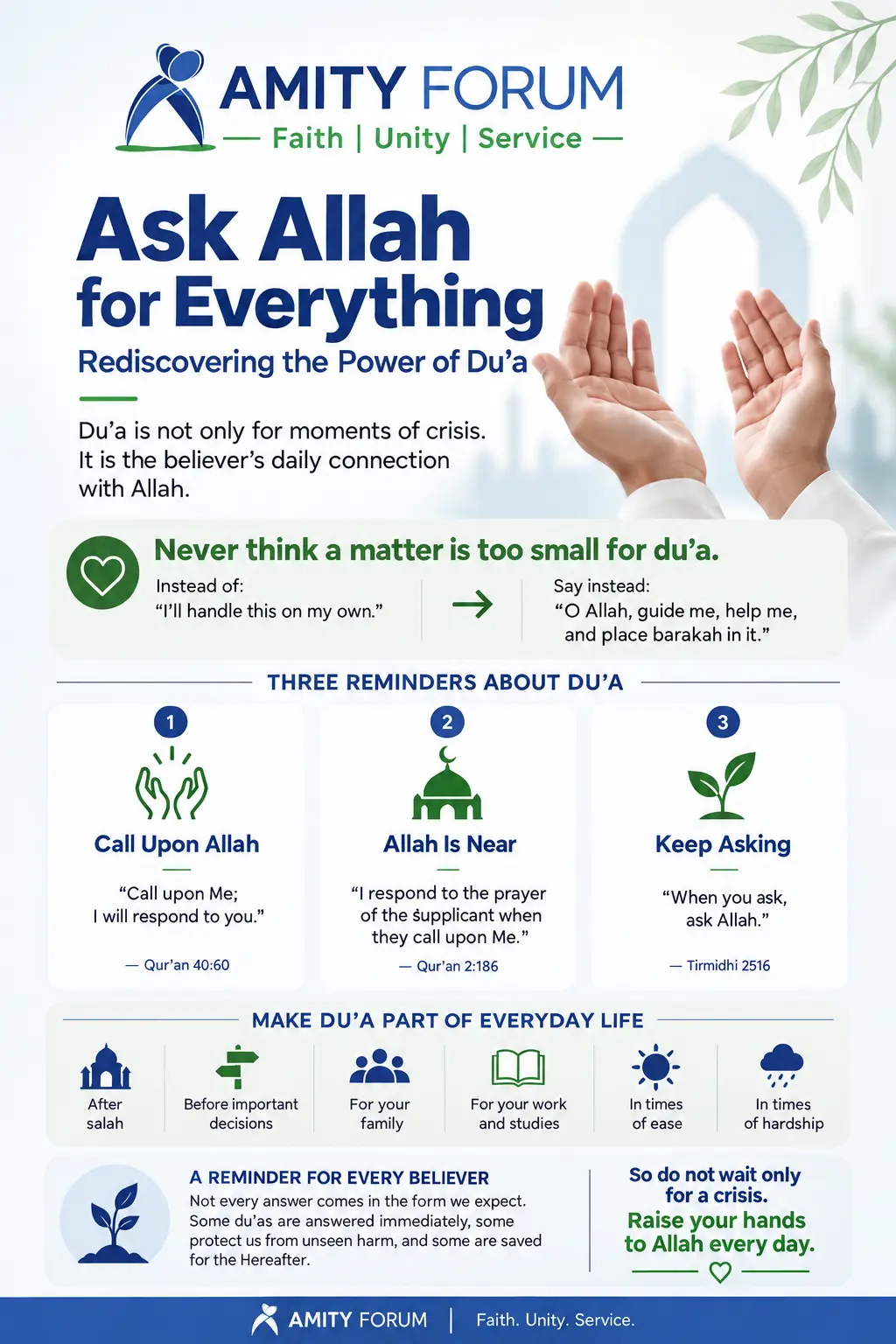
We often turn to duʿa most deeply when life becomes difficult. Illness, financial pressure, uncertainty, or an important decision can suddenly remind us how little we truly control. In such moments, calling upon Allah feels natural. But duʿa was never meant to be reserved only for crisis. It is meant to accompany the believer through everyday life, shaping the way we hope, work, decide, and depend upon Allah.
“Call upon Me; I will respond to you.”
Qur’an 40:60وَقَالَ رَبُّكُمُ ٱدْعُونِىٓ أَسْتَجِبْ لَكُمْ ۚ إِنَّ ٱلَّذِينَ يَسْتَكْبِرُونَ عَنْ عِبَادَتِى سَيَدْخُلُونَ جَهَنَّمَ دَاخِرِينَAnd your Lord says, "Call upon Me; I will respond to you." Indeed, those who disdain My worship will enter Hell [rendered] contemptible.Ghafir 40:60 · Sahih International
This is not merely permission to ask; it is an invitation to remain connected to Him.
Duʿa Teaches Us Where Our Dependence Lies
Islam encourages effort, responsibility, preparation, and the use of lawful means. We study, work, seek advice, develop our skills, and make careful decisions. Yet the believer knows that none of these things can guarantee an outcome.
Our qualifications, savings, experience, and contacts may all be useful, but the result still belongs to Allah. This is why the Prophet ﷺ taught Ibn ʿAbbas:
“When you ask, ask Allah; and when you seek help, seek Allah’s help.”
The lesson is not to abandon practical action. It is to keep our hearts attached to Allah while our hands remain busy with effort. We take the means available to us, but we do not mistake the means for the One who controls them.
Nothing Is Too Small to Ask
Sometimes we reserve duʿa for major problems, as though ordinary concerns are too small to bring before Allah. But no request is insignificant to the One whose generosity has no limit.
We can ask Allah to make our work easier, place barakah in our income, protect our families, guide us through a difficult conversation, help us control our anger, or give us clarity when we feel uncertain. We can ask for a better decision, a calmer heart, or simply an easier day.
People may become tired when we ask repeatedly. Allah does not. Our asking does not diminish what He possesses, and returning to Him again and again is itself an act of worship.
When the Answer Comes Differently
One of the most comforting teachings about duʿa is that a sincere supplication is never wasted. The Prophet ﷺ taught that Allah may grant what was asked, remove a harm in its place, or preserve its reward for the Hereafter.
When the Companions heard this, they said they would increase their supplications. The Prophet ﷺ replied that Allah has even more to give.
This changes the way we understand prayers that seem unanswered. Sometimes the answer comes exactly as we hoped. At other times, a closed door may be protection, and a delay may carry wisdom we cannot yet see. Something we want deeply today may not be good for us in the way or at the time we imagined.
Duʿa teaches us to ask with hope while trusting Allah with the outcome.
Allah Is Near
“When My servants ask you about Me, I am truly near. I respond to the prayer of the supplicant when they call upon Me.”
Qur’an 2:186وَإِذَا سَأَلَكَ عِبَادِى عَنِّى فَإِنِّى قَرِيبٌ ۖ أُجِيبُ دَعْوَةَ ٱلدَّاعِ إِذَا دَعَانِ ۖ فَلْيَسْتَجِيبُوا۟ لِى وَلْيُؤْمِنُوا۟ بِى لَعَلَّهُمْ يَرْشُدُونَAnd when My servants ask you, [O Muhammad], concerning Me - indeed I am near. I respond to the invocation of the supplicant when he calls upon Me. So let them respond to Me [by obedience] and believe in Me that they may be [rightly] guided.Al-Baqara 2:186 · Sahih International
A person does not need perfect words or a special place to make duʿa. It can happen while travelling to work, sitting after salah, lying awake at night, or waiting quietly for news. Some of the most sincere prayers are simple words spoken from the heart.
There are worries we struggle to explain to others and hopes we may never say aloud. Duʿa gives all of them a place to go.
Begin With Duʿa, Then Act
Many of us treat duʿa as the final option. We first search for solutions, ask people, calculate possibilities, and try everything we can. Only when those options fail do we turn to Allah.
A better habit is to begin with duʿa and then act. Ask Allah for guidance before seeking advice, for provision while working, for healing while seeking treatment, and for success while preparing well.
Duʿa does not replace effort, and effort does not replace duʿa. They belong together. The believer works seriously while knowing that every result still depends upon Allah.
Make Duʿa Personal
The supplications taught in the Qur’an and Sunnah are precious, but duʿa should never become only a mechanical routine. We should also learn to speak to Allah sincerely about our own lives.
We can make duʿa for our parents, spouse, children, work, debts, fears, ambitions, weaknesses, and future. We can ask Allah to preserve what is good, correct what is wrong within us, and guide us in what we do not understand.
We should not make duʿa only when life is difficult. We should also ask Allah to preserve our blessings, deepen our gratitude, and keep our hearts close to Him when life becomes easy.
Keep Asking
There may be times when a person feels they have made the same duʿa too many times. They may have asked for months or years and begun to wonder whether they should stop. The believer, however, should never lose hope in the generosity of Allah.
Allah is not exhausted by our needs, and His generosity is not reduced by our requests. We should ask Him for the great matters and the small ones, for this life and the next, for ourselves and for those we love.
Sometimes the greatest gift of duʿa is not simply receiving what we asked for. Sometimes it is what happens to the heart through the asking: it learns humility, patience, hope, and trust.
Duʿa does more than seek a change in our circumstances. It quietly changes the person who keeps turning to Allah.